
Regression Fallacy
Where was the first money spent?
Before money was worth anything as money, it was worth something as stuff. This is the famous regression theorem of Ludwig von Mises. Bitcoiners end up talking about it a lot because Mises is one of the grandaddies of Austrian economics and the theorem seems to imply that Bitcoin can’t be money.
It starts by asking how it is that people are willing to trade real things for something like money, which seems kind of made up. I’m happy to take money in exchange for my time or my stuff because I’m fairly confident that other people will take the money when I want some of their time or stuff. Mostly, I don’t think about it much.
But…if you do think about it, you might ask: if the only reason money has value is because it is money, how did it get to be money? In order to use money, you need to have an idea of what it’s worth, but you can only get this idea if someone else is already using it as money. And now we’re just going in circles.
This is where regression comes in. Mises says money has value today because it was used as money yesterday. I don’t find this very helpful because:
To trace back the value that money has today to that which it had yesterday, the value that it had yesterday to that which it had the day before, and so on, is to raise the question of what determined the value of money in the first place. Mises, The Theory of Money and Credit
No kidding. Rothbard asks our burning question for us:
Does not the fact that this causes partially regress backward in time simply push the unexplained components back further without end? If today’s prices are partly determined by yesterday’s prices, and yesterday’s by those of the day before yesterday, etc., is not the regression simply pushed back infinitely, and part of the determination of prices thus left unexplained?
Mises says, “Don’t worry! People only ever use things for money that were already considered valuable, so we’ll just go back to when the thing wasn’t money and see what is was worth then.”
The first value of money was clearly the value which the goods used as money possessed (thanks to their suitability for satisfying human wants in other ways) at the moment when they were first used as common media of exchange. Mises, The Theory of Money and Credit
Apparently, the grand answer provided by the regression theorem is this: money originally gets its value from the thing it’s made of and money is only ever made of things that lots of people already want. I don’t find this answer very satisfying. When it comes to money, it feels to me like we’re not just dealing with a difference of degree (the most saleable good) but instead are talking about a different kind of thing.
It reminds me of another kind of regression problem:
“Who did the first grammar mutant talk to?”
I wish I could claim this formulation as my own, but, alas, Steven Pinker wrote it. You see where it’s headed, though: if evolution works by mutations and extinctions, whichever of our ancestors won the lottery with a language mutation must have had some trouble finding a conversation partner. Linguists have to answer a question of the same nature as Mises: how does what you say when you speak a word get its meaning?
The sound of our words is somewhat arbitrary. It doesn’t seem like there’s a reason that the sound you make when you mean one thing should be the sound I make when I mean the same thing. Just look at how many languages there are or take a quick look at how people in different places record the sounds animals make (in French, crows say croc?)…if the sounds of different words are arbitrary, how did people learn what they meant?
Regression is the easy answer here: we learned it from our parents. But where did they learn it? From their parents, and their parents before them. But does this not “simply push the unexplained components back further without end” as Rothbard said?
People call this Wallace’s Problem because it was Alfred Russel Wallace who formulated a broader version of it in a letter to Darwin:
Natural selection could only have endowed the savage with a brain a little superior to that of an ape whereas he possesses one very little inferior to that of an average member of our learned societies.
Or as another guy put it:
Human language is an embarrassment for evolutionary theory because it is vastly more powerful than one can account for in terms of selective fitness. [David Premack, “Gavagai!” or the future history of the animal language controversy. Cognition, 19 207-296]
Unlike the Austrians, the linguists and biologists don’t have a consensus about how to solve their regression. People like Noam Chomsky and Steven Pinker have made entire careers talking about this problem. For a long while, Chomsky’s was the leading theory and it pretty much said that once upon a time there was a grammar mutant who happened to provide us with a “Language Acquisition Device” (I guess he’s calling it Merge now?). Lately, something like Pinker’s Language Instinct gene may be a more popular explanation. I don’t find either of them very satisfying as origin stories.
Others have proposed something a little better. Derek Bickerton has a nice story of how people developed language because they had to tell each other about far-off dead animals that made for good scavenging. Or biologists like Madeline Beekman talk about language evolving as a result of our ancestors’ tendency to care for their young communally.
Whatever explanation you find most satisfying, it’s interesting to compare this regression problem to the one Mises encountered with money: if linguists were Austrians, they might believe that every language must begin with sounds. And no language could exist, except that it started with sounds. And perhaps even that all meaning has its basis in the sounds things make…how else did it get its meaning?
What was Bitcoin’s use-value before it was money?
Bitcoiners have felt a little awkward around the regression theorem almost from the very beginning. There’s a great BitcoinTalk post from 2010 that, with a few mental acrobatics, excuses Bitcoin’s regression theorem violations because it emerged in an economy that was already monetized (with plenty of prices to reference):
The essential point is that once exchange can occur between a money (USD) and Bitcoins, providers of goods have a means by which to value Bitcoins as a potential medium of exchange. The money regression is satisfied, because taken back far enough we reach traditional commodity money: BITCOINS -> USD -> MONETIZED GOLD & SILVER [start monetary economy] -> [end barter economy] COMMODITY GOLD & SILVER.
Apparently, when Mises said “no good can be employed for the function of a medium of exchange which at the very beginning of its use for this purpose did not have exchange value on account of other employments,” he actually meant “once we’ve got prices in the market, all bets are off and anything can be money.”
Konrad Graf wrote a 2013 post which attempts a more extensive solution to Bitcoin’s problem with the regression theorem. He begins by pointing out that Mises didn’t propose the regression theorem as a historical observation, but rather as a logical statement:
And all these statements implied in the regression theorem are enounced apodictically as implied in the apriorism of praxeology. It must happen this way. Nobody can ever succeed in construction a hypothetical case in which things were to occur in a different way. Mises, Human Action
In order to use money, people have to be able calculate how much a given money is worth and Mises figured that no one could make such a calculation without a starting point. Hence, the rather strong way of asserting “it must happen this way.” The argument doesn’t need any historical evidence anymore than the distributive property of multiplication needs evidence. “How else could it work?” If people use something as money, they must have had a starting point for calculating its worth.
“Therefore,” allows Graf (even though he does not need to), “the only challenge for the regression theorem/bitcoin relationship is to find any direct-use or direct-exchange value prior to and separable from the emergence of indirect-exchange value.”
And so Graf speculates that before Bitcoin had value as money, it had “geek value” or “mystique value” or “curiosity value” – perhaps “there was some degree of direct value to the relevant hacker-actors just for the sake of creating them.” I don’t buy it.
Bitcoin is money. Always has been.
These regression theorem explanations feel like fancy carnival tricks or elaborate excuses to me. When Satoshi introduced Bitcoin to the world, he wrote:
I’ve been working on a new electronic cash system that’s fully peer-to-peer, with no trusted third party.
The title of the whitepaper is “Bitcoin: A Peer-to-Peer Electronic Cash System”
It was clearly intended to be money and anyone who reads the whitepaper is hard-pressed to believe that it was something other than money that they were dealing with. Why do we have to pretend that Bitcoin wasn’t valued as money from the very start? Well, we have to do it because the regression theorem says it must be so. But – now I’m going to say something that sounds stupid – what if we are regressing toward the wrong thing?
I wonder if Mises made a mistake in focusing on the most saleable good aspect of money and trying to trace money’s value back to some thing from the land of barter. Perhaps it makes more sense to think of it as a language.
Money is a language
I’m hardly the first person to notice the similarities between language and money.
Adam Smith thought it probable that the the human propensity to “truck, barter, and exchange one thing for another” was the “necessary consequence of the faculties of reason and speech.”
If we should enquire into the principle in the human mind on which this disposition of trucking is founded, it is clearly the natural inclination every one has to persuade. The offering of a shilling, which to us appears to have so plain and simple a meaning, is in reality offering an argument to persuade one to do so and so as it is for his interest. -Lectures on Jurisprudence
You could easily say the same of words and language in general. Why else do we speak them if not to persuade? Nietzsche called trade “the oldest and most original personal relationship that there is, the relationship between buyer and seller, creditor and owner.” And Mises said that “Money has thus become an aid that the human mind is no longer able to dispense with in making economic calculations” which sounds a lot like the way Chomsky talks about language as a framework for thought.
Modern Austrian economists carry on this thread. Steven Horwitz said, “Just as we cannot help but think in terms of the words that language provides us, we cannot help but act in the market in terms of the money prices of what we want to exchange.” Money is rather more integral than a shiny rock would make you think. Horwtiz continues:
If money is an analog to language, then price is the analog to word. A market price embodies knowledge made available by exchanges through the medium of money, just as a word is knowledge made available by speaking or writing in a language. Therefore, just as a word does not correspond to some objective thought or meaning, so does a price not correspond to some objective quality of the object being bought or sold, or some objectively measurable cost. Prices are socially constructed unintended consequences of our attempts to act purposively within the context of monetary exchange. Words and prices both evolve through their use as “aids to the mind.”
I find this a very useful way to think about money. I struggle to reconcile the regression theorem’s insistence that money always comes from some valued thing (a most saleable good) with an understanding of value as subjective – humans value whatever suits their fancy, however suits their fancy. While money may have used goods as a scaffold on which to build itself, goods are no more integral to money than sounds are to language. Humans can communicate with written words or flashes of light, they can use sign-language or ideograms – and our money can be whatever makes sense to people – even if it’s agreeing on the state of a database every ten minutes on average.
Gold doesn’t lie, neither does Bitcoin
So why do we use things for money at all? Why not just use words? Umberto Eco pointed out that “the only difference between a coin and a word is that the word can be reproduced without economic effort, while the coin is an irreproducible item.” Humans used things like gold as the sounds of this particular money-language because we had no other way to prevent people from lying.
Words are infamously easy to say. But money isn’t a very useful language if it isn’t connected to the stuff of the world, somehow. Money doesn’t require grounding in a commodity’s value to set prices, it needs grounding to to achieve scarcity. Before Bitcoin, no one had figured out a way to make irreproducible words, so we had to rely on stuff to do the job for us.
Satoshi wrote an interesting response to that BitcoinTalk post about the regression theorem. He identified that scarcity is really the important thing here:
But if there were nothing in the world with intrinsic value that could be used as money, only scarce but no intrinsic value, I think people would still take up something.
I like this framing of the problem of the regression theorem: it may seem like the we need something that was useful for other reasons to “spark” the value of money, but it’s actually that we need scarcity to make money work. People will “take up something” because it’s part of what we do.
If money is a language, how does it get a price? Isn’t it just a bunch of words? I think the answer is that people just give it a shot. This guy did:
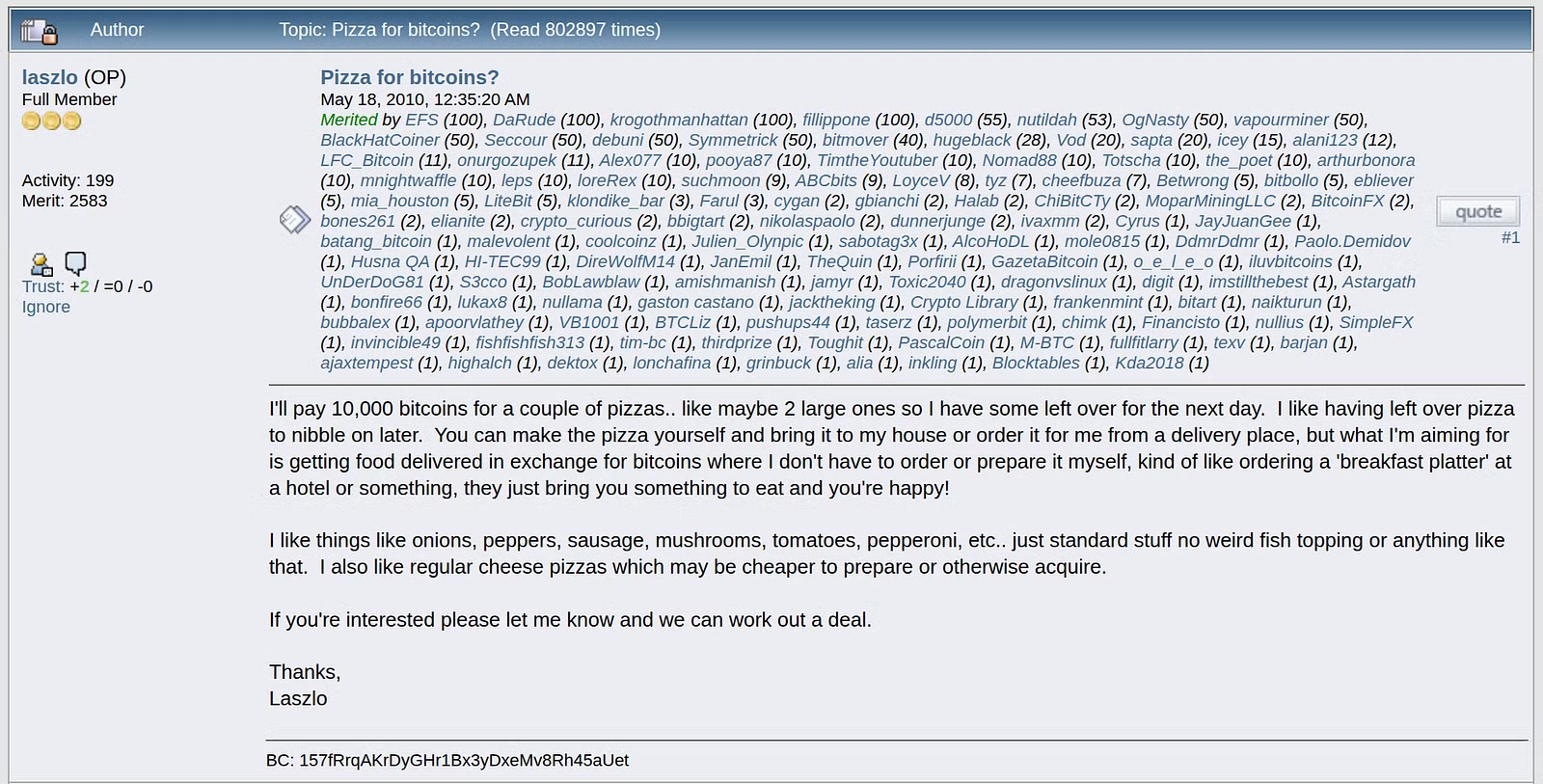
I’ve been reading Cryptoeconomics again, and this is an attempt to work through some of the ideas in the chapter called “Regression Fallacy” which I am copying below.
Cryptoeconomics: Regression Fallacy
The Regression Theorem relies on the assumption that the first people to value something as a money must do so based on a memory of its prior use value, with the thing eventually obtaining barter utility and finally monetary value. The theorem is invalid based on three internal contradictions.
No good can be employed for the function of a medium of exchange which at the very beginning of its use for this purpose did not have exchange value on account of other employments.
Ludwig Von Mises: Human Action
Notice that the theory does not merely attempt to explain the origin of the money concept, but of anything that can be a money. In other words, if a good does not follow this progression, it is not money.
The theorem contradicts the subjective theory of value upon which the theorem relies. Value is subjective, which implies it can be based on anything, even if objectively that basis appears irrational.
The theorem fails to terminate its regression by not explaining how a person comes to value something for its original utility. One must assume (not remember) something will be useful if nobody has ever attempted to use it. This assumption of utility is the first valuation, which remains subjective. The first valuation of a thing, like all after, can be for any reason, including its utility as a money.
Given a preexisting concept of money, it has been suggested that anticipation of being a money is sufficient to satisfy the theorem. In other words the money does not need to follow the progression in actual practice. In this case, given a preexisting concept of money, anything can begin as money. This interpretation renders the theorem tautological - anything that people value as money can be money. In other words, it reduces to subjective first value.
The theorem is actually based on empirical observation of monetary evolution. Yet the rational economic theory on which is based, and the theorem itself, explicitly rejects empiricism.
All these statements implied in the regression theorem are enounced apodictically as implied in the apriorism of praxeology. It must happen this way. Nobody can ever succeed in construction a hypothetical case in which things were to occur in a different way.
One of many problems with empirical economics is that new observations can invalidate previous conclusions. Bitcoin has done so to this theorem. It can clearly be observed that Satoshi intended to create a money, for its first use as money.
The idea is a reasonable empirical theory on the evolution of the concept of money, but invalid as a rational theorem to distinguish money from non-money. Money is distinguished by certain behaviors expressed by people. Concluding that something is a money consists of observing those behaviors, a strictly empirical method.